Not ready for a Complete Pen Test? How about finding out your Cyber Score in 2 mins? Click here for your Cyber Score

Published by Capital Cyber | Leesburg, VA | (571) 410 3066
Ask ten defense contractors what the difference is between NIST 800-171 and CMMC, and you’ll get ten slightly different answers. Some will tell you they’re the same thing. Some will say NIST is the old rule and CMMC is the new one. Some will insist CMMC “replaced” NIST.
None of that is quite right.
Here’s the truth: NIST 800-171 and CMMC are not competing frameworks. They work together. One defines what you have to do. The other defines how you have to prove it. Understanding the difference is the first step to building a compliance strategy that actually protects your DoD contracts.
This guide breaks down NIST 800-171 vs CMMC – what each one is, how they relate, and which one applies to your business in 2026.
If you handle CUI for the DoD, both apply to you. CMMC does not replace NIST 800-171 – it enforces it.
NIST Special Publication 800-171 – officially titled “Protecting Controlled Unclassified Information in Nonfederal Systems and Organizations” – is a cybersecurity standard published by the National Institute of Standards and Technology.
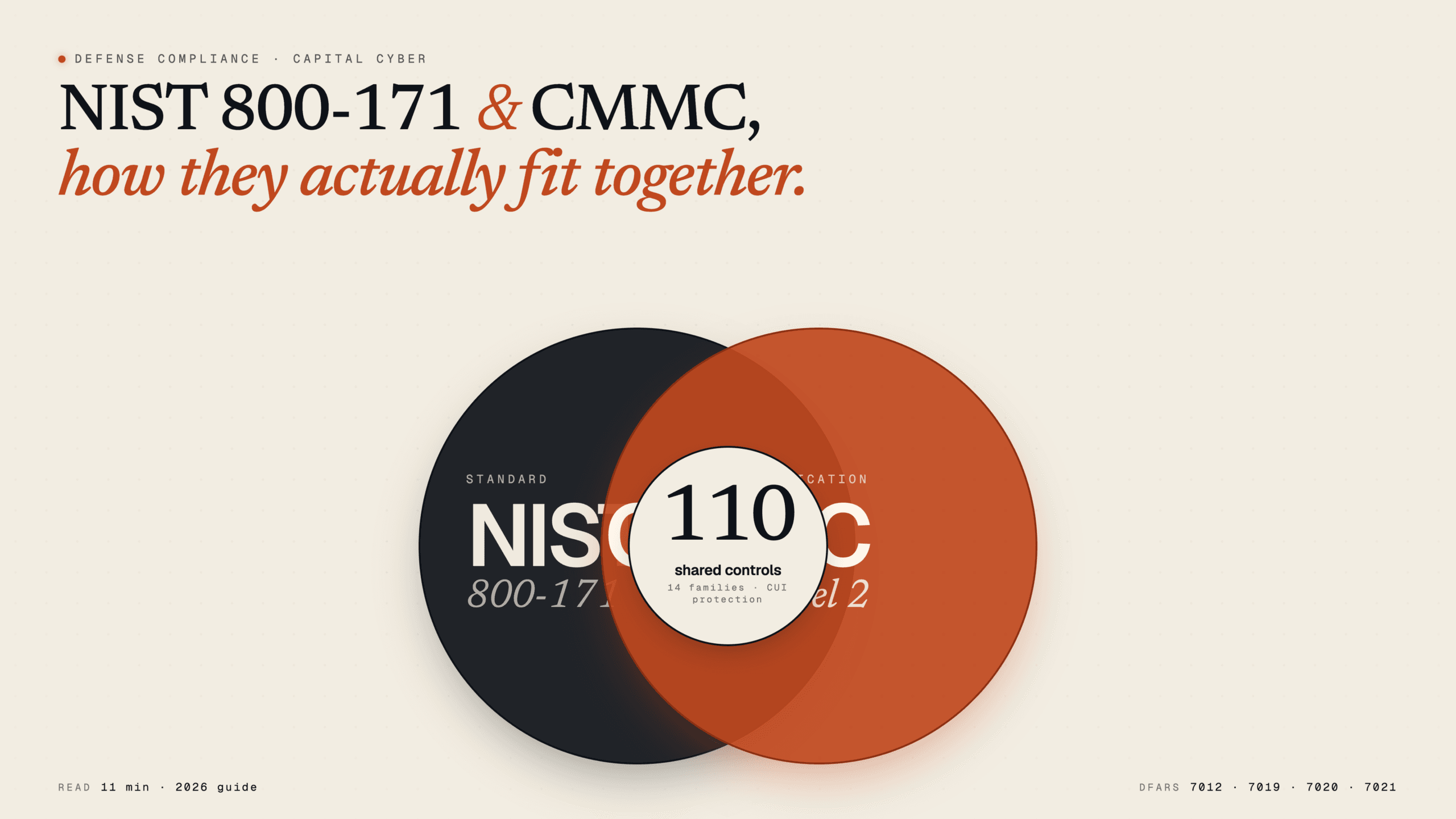
It defines 110 security requirements across 14 control families for protecting CUI when it lives on non-federal systems. The current version in effect is NIST 800-171 Rev. 2 (February 2020, updated January 2021), though NIST 800-171 Rev. 3 is in the pipeline and the DoD has already published organization-defined parameters (ODPs) in preparation for its eventual adoption.
Key characteristics of NIST 800-171:
The 14 control families in NIST 800-171 are the same 14 families you see in CMMC Level 2: Access Control, Awareness and Training, Audit and Accountability, Configuration Management, Identification and Authentication, Incident Response, Maintenance, Media Protection, Personnel Security, Physical Protection, Risk Assessment, Security Assessment, System and Communications Protection, and System and Information Integrity.
CMMC – the Cybersecurity Maturity Model Certification – is the Department of Defense’s certification program that verifies defense contractors have actually implemented the security controls they claim.
CMMC 2.0 is structured into three levels:
Key characteristics of CMMC:
The easiest way to understand the relationship: NIST 800-171 is the rulebook. CMMC is the referee.
NIST tells you what to do. CMMC tells you who’s watching, how often they’re watching, and what happens if you don’t comply. The 110 controls at CMMC Level 2 are the exact same 110 controls in NIST 800-171 Rev. 2. CMMC did not invent new controls – it created a verification program to make sure the existing NIST controls were actually implemented.
NIST SP 800-171 Rev. 2 → The cybersecurity controls (the what)
DFARS 252.204-7012 → The contract clause requiring NIST 800-171 (the legal basis)
CMMC Level 2 → The certification that verifies implementation (the proof)
DFARS 252.204-7021 → The contract clause requiring CMMC certification (the enforcement)
Pre-CMMC, DFARS 7012 required contractors to implement NIST 800-171 – but compliance was based on self-attestation. Contractors reported scores to SPRS with no independent verification. That system failed because too many contractors claimed compliance they never implemented.
CMMC exists specifically to close that gap with independent, evidence-based verification.
Dimension | NIST SP 800-171 | CMMC |
Type | Security standard | Certification program |
Authority | NIST | DoD |
Scope | Federal government-wide | DoD contractors |
Number of controls | 110 | 15 (L1), 110 (L2), 134 (L3) |
Verification | Self-attestation | Self-assessment + C3PAO + DIBCAC |
Scoring | No formal scoring | 110-point scale (88 to pass) |
Certification | None required | Required for most DoD CUI work |
POA&M flexibility | Generous – begin work with open POA&Ms | Restricted – critical controls cannot be on POA&M; 180-day closeout |
Annual assessment | Self-assessment expected | L1 annual, L2 triennial with annual affirmations |
Enforcement | DFARS 252.204-7012 | DFARS 252.204-7021 |
The biggest practical difference: Under NIST 800-171, you could begin contract work with open POA&Ms. Under CMMC, you cannot – you must meet minimum score thresholds, implement certain non-negotiable controls, and close all remaining POA&Ms within 180 days. CMMC is stricter, formalized, and enforced.
Practical reality for defense manufacturers: If you have DFARS 7012 in your contracts and you handle any CUI, assume both NIST 800-171 and CMMC Level 2 apply. The DoD treats compliance with both as the cost of doing defense business.
NIST 800-171 and CMMC don’t exist in a vacuum. They’re connected by a family of DFARS clauses that every defense contractor should recognize:
If you see any of these in your contracts, assume CMMC applies to you.
There’s a transition on the horizon. NIST published 800-171 Rev. 3 in 2024, and the DoD has issued organization-defined parameters (ODPs) signaling that Rev. 3 will eventually replace Rev. 2 as the standard under DFARS 7012 and CMMC.
As of 2026, Rev. 2 remains the active standard. CMMC is built on 800-171 Rev. 2, and your assessments will use Rev. 2’s 110 controls.
That said, defense contractors should review Rev. 3 now and prepare. Key changes include:
Capital Cyber recommends building your SSP and compliance program flexibly enough that a future Rev. 3 transition is a documentation update, not a ground-up rebuild.
Wrong. CMMC is built on NIST 800-171. You need both.
Not quite. Being NIST-compliant means you’ve implemented the controls. CMMC requires evidence-based verification of those controls through a formal assessment – and that raises the bar significantly.
CMMC is far stricter. Level 1 allows zero POA&Ms. Level 2 allows POA&Ms only for narrow, non-critical controls – and every POA&M must close within 180 days or your certification expires.
False. Other federal agencies can reference NIST 800-171 in their contracts. NIST 800-171 is government-wide. CMMC is DoD-specific.
Not yet. Rev. 2 remains the active standard under DFARS 7012 and CMMC as of 2026. Rev. 3 is in transition.
If you’re a defense manufacturer trying to align NIST 800-171 and CMMC efforts, here’s the practical roadmap Capital Cyber recommends:
Step 1: Confirm whether your contracts reference DFARS 7012, DFARS 7021, or both. Look in every active contract, every recompete, and every option exercise.
Step 2: Determine whether you handle FCI, CUI, or both. FCI alone = CMMC Level 1. CUI = CMMC Level 2 (which means all 110 NIST 800-171 controls).
Step 3: Build a System Security Plan aligned to NIST 800-171 Rev. 2, structured so it will serve as your CMMC Level 2 SSP.
Step 4: Calculate and submit your NIST 800-171 self-assessment score to SPRS with an accurate senior official affirmation.
Step 5: Begin CMMC Level 2 readiness in parallel – gap assessment, remediation, documentation, and C3PAO scheduling.
Step 6: Monitor NIST 800-171 Rev. 3 developments and update your SSP format in preparation for the eventual transition.
External References
Related Resources
Ready to Get Started?
NIST 800-171 vs CMMC is not a competition – it’s a partnership. NIST defines the security controls that protect CUI. CMMC enforces them through certification. DFARS 7012 and 7021 make both mandatory for defense contractors.
For defense manufacturers in 2026, the question isn’t “which one do I need?” – the question is how efficiently you can align both programs under a single compliance roadmap.
Confused about how NIST 800-171 and CMMC apply to your contracts?
Capital Cyber helps defense manufacturers and DoD contractors cut through the compliance alphabet soup with clear, right-sized roadmaps. We build one program that satisfies DFARS 7012, NIST 800-171, and CMMC together – not three separate projects.
Book a free Compliance Strategy Call: https://capital-cyber.com/contact/
One framework. One roadmap. Your path from confusion to certification starts here.
One framework. One roadmap. Your path from confusion to certification starts here.
Practical compliance. Real progress. Your path from gap to certification starts with one honest conversation.
Do not wait until you lose a contract to take action. Call (571) 410 3066 or visit capital-cyber.com for a free CMMC readiness consultation.
Capital Cyber | 1019B Edwards Ferry Rd. #1183, Leesburg, VA 20176
Security Obsessed. Service Driven.